My research focuses on developing trustworthy, explainable, and human-centered AI for healthcare.
Approach: Build AI systems that are accurate, interpretable, fair, and clinically meaningful.
Applications: Clinical prediction, patient-level analysis, and healthcare decision support.
Across modalities: Electronic health records (EHRs), clinical text, structured/tabular data, biomedical signals, and medical images.
02 / RESEARCH
Research & interests
Current PhD research
Clinical Natural Language Processing (Clinical NLP): Developing and evaluating NLP and large language model methods for clinical and healthcare applications.
AI with real-world clinical data: Working with patient data from the University of Pittsburgh Medical Center (UPMC) to automate the extraction of cause-of-death labels from patient encounter notes.
Trustworthy & fair clinical AI: Investigating model bias, fairness, interpretability, and reliability; identifying and mitigating disparities across patient populations.
LLMs in healthcare: Exploring model use, evaluation, and reasoning, including how well models capture clinically meaningful information, support reliable healthcare decisions, and inform frameworks for implementing LLMs in healthcare systems.
Prior research
Explainable AI for healthcare: Interpretable disease and health-risk prediction using demographic, behavioral, socioeconomic, family, and health information.
Fairness & bias mitigation: Investigating racial and demographic bias in medical AI, particularly skin cancer prediction, and developing more equitable models.
Biomedical signal analysis: EEG-based emotion recognition and consumer preference prediction; identifying important brain regions and electrodes using interpretability methods.
Generative AI & synthetic data: Generating and augmenting text, tabular data, and images to address limited data and class imbalance.
LLMs for structured clinical data: Transforming tabular clinical data into text for disease prediction, paraphrasing-based clinical text augmentation, and interpretable clinical reasoning.
Federated & efficient AI: Distributed learning approaches that combine neural feature extraction with boosting-based prediction to improve predictive performance while reducing computational costs and training time across participating devices.
Research interests
Clinical AI: Clinical NLP, large language models, multimodal learning, and machine learning with real-world clinical data.
Trustworthy systems: Explainability, fairness, bias identification and mitigation, reliability, and clinically meaningful reasoning.
Methods: Generative modeling, neural networks, agentic AI and agentic modeling, synthetic data generation, and multimodal learning.
Data modalities: Electronic health records (EHRs), clinical text, structured/tabular data, biomedical signals, and medical images.
Goal: Develop clinically useful, transparent, equitable, and trustworthy AI systems that support healthcare professionals and patient-centered outcomes.
03 / PUBLICATIONS
Publications & ongoing research
Journal2025
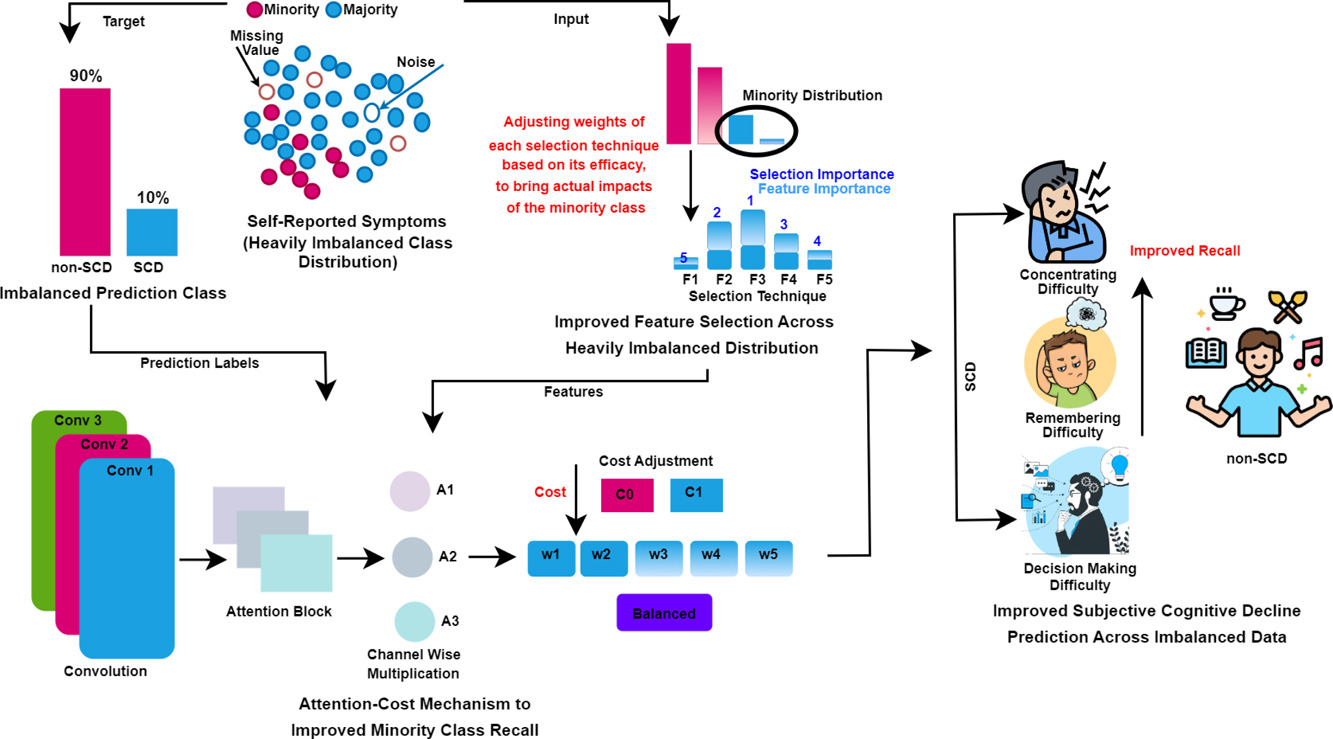
Early Detection of Subjective Cognitive Decline from Self-Reported Symptoms: An Interpretable Attention Cost Fusion Approach.
Authors:Simon Bin Akter, Sumya Akter, Rakibul Hasan, Md Mahadi Hasan, A.M. Tayeful Islam, Tanmoy Sarkar Pias, Jorge Fresneda Fernandez, Md Golam Rabiul Alam, and David Eisenberg.
Background and Objective: Subjective cognitive decline (SCD) refers to self-reported difficulties in concentration, memory, and decision-making. Since SCD is based on subjective experiences, no specific medical test can definitively confirm its presence, making early detection challenging. Thus, it is advantageous to develop an AI model to capitalize on self-reported health complications, personality traits, and sociodemographic factors for early detection of SCD.
Methods & Materials: This research has proposed an AI-based framework for SCD detection using self-reported measures from the BRFSS 2021 dataset. A novel Weighted Fusion Selection (WFS) approach has been introduced, which combines multiple feature selection techniques to address class imbalance and identify relevant features associated with less frequent classes. The data set has shown a significant imbalance, with individuals at risk of SCD being 81.76% fewer than those not at risk. An Attention Cost Convolutional Neural Network (AC-CNN) has been developed to address this, integrating channel-wise attention mechanisms and cost-sensitive learning to enhance performance across imbalanced data.
Results: The AC-CNN model has achieved a balance between specificity (77%) and sensitivity (81%), with an AUC-ROC of 0.87. This has represented an overall 24.8% improvement in handling class imbalance compared to prior studies. Additional testing on the NHIS 2022 dataset has shown that AC-CNN has maintained balanced performance, confirming its robust generalizability, while other models have remained unstable.
Conclusions: Further, applying SHapley Additive exPlanations (SHAP) explainable techniques to the AC-CNN model has revealed how individual aspects of an individual’s health records, lifestyle, and demographics contribute to the prediction of SCD. For example, depression, low education, poor income, inadequate healthcare, and poor overall health have all been strongly linked to an increased risk of SCD.
Highlights
AI-based SCD prediction from self-reported symptoms for widespread screening.
Channel-wise attention in CNNs enhances feature representation for class imbalance.
Minority class cost allocation ensures balanced specificity and sensitivity.
Weighted feature selection highlights underrepresented features in imbalanced data.
SHAP interprets health, lifestyle, and demographics in SCD prediction.
Graphical Abstract
Journal2025
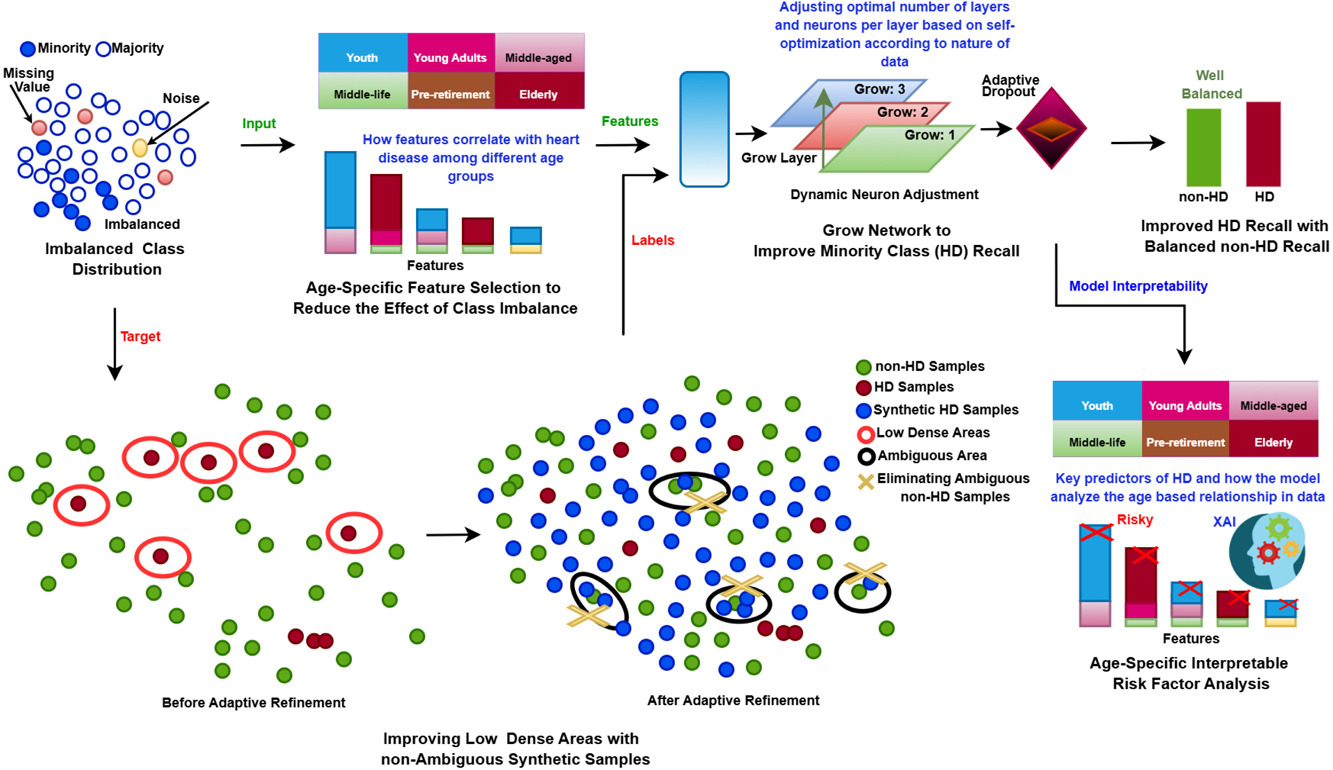
Optimizing Stability of Heart Disease Prediction Across Imbalanced Learning with Interpretable Grow Network.
Authors:Simon Bin Akter, Sumya Akter, Rakibul Hasan, Md Mahadi Hasan, Tanmoy Sarkar Pias, Riasat Azim, Jorge Fresneda Fernandez, and David Eisenberg.
Venue: Computer Methods and Programs in Biomedicine
Background and objectives: Heart disease prediction models often face stability challenges when applied to public datasets due to significant class imbalances, unlike the more balanced benchmark datasets. These imbalances can adversely affect various stages of prediction, including feature selection, sampling, and modeling, leading to skewed performance, with one class often being favored over another.
Methods: To enhance stability, this study proposes a Grow Network (GrowNet) architecture, which dynamically configures itself based on the data’s characteristics. To enhance GrowNet’s stability, this study proposes the use of TriDyn Dependence feature selection and Adaptive Refinement sampling, which ensure the selection of relevant features across imbalanced data and effectively manage class imbalance during training.
Results: When evaluated on the benchmark UCI heart disease dataset, GrowNet has outperformed other models, achieving a specificity of 92%, sensitivity of 88%, precision of 90%, and F1 score of 90%. Further evaluation on three public datasets from the Behavioral Risk Factor Surveillance System (BRFSS), where heart disease cases constitute only about 6% of the data, has demonstrated GrowNet’s ability to maintain balanced performance, with an average specificity, sensitivity, and AUC-ROC of 77.67%, 81.67%, and 89.67%, respectively, while other models have exhibited instability. This represents a 22.8% improvement in handling class imbalance compared to prior studies. Additional tests on two public datasets from the National Health Interview Survey (NHIS) have confirmed GrowNet’s robustness and generalizability, with an average specificity, sensitivity, and AUC-ROC of 80.5%, 82.5%, and 90%, respectively, while other models have continued to demonstrate instability.
Discussion: To enhance transparency, this study incorporates SHapley Additive exPlanations (SHAP) analysis, enabling healthcare professionals to understand the decision-making process and identify key risk factors for heart disease, such as bronchitis in midlife, renal dysfunction in the elderly, and depressive disorders in individuals aged 35–44.
Conclusion: This study presents a robust, interpretable model to assist healthcare professionals in cost-effective, early heart disease detection by focusing on key risk factors, ultimately improving patient outcomes.
Highlights
GrowNet adjusts layers and neurons, ensuring high recall for minority classes.
Adaptive Refinement improves low-density representation, reducing class bias.
Age-based selection highlights feature importance per age group, revealing insights.
Age-specific interpretability shows how health factors impact heart disease by age.
Graphical Abstract
Journal2024
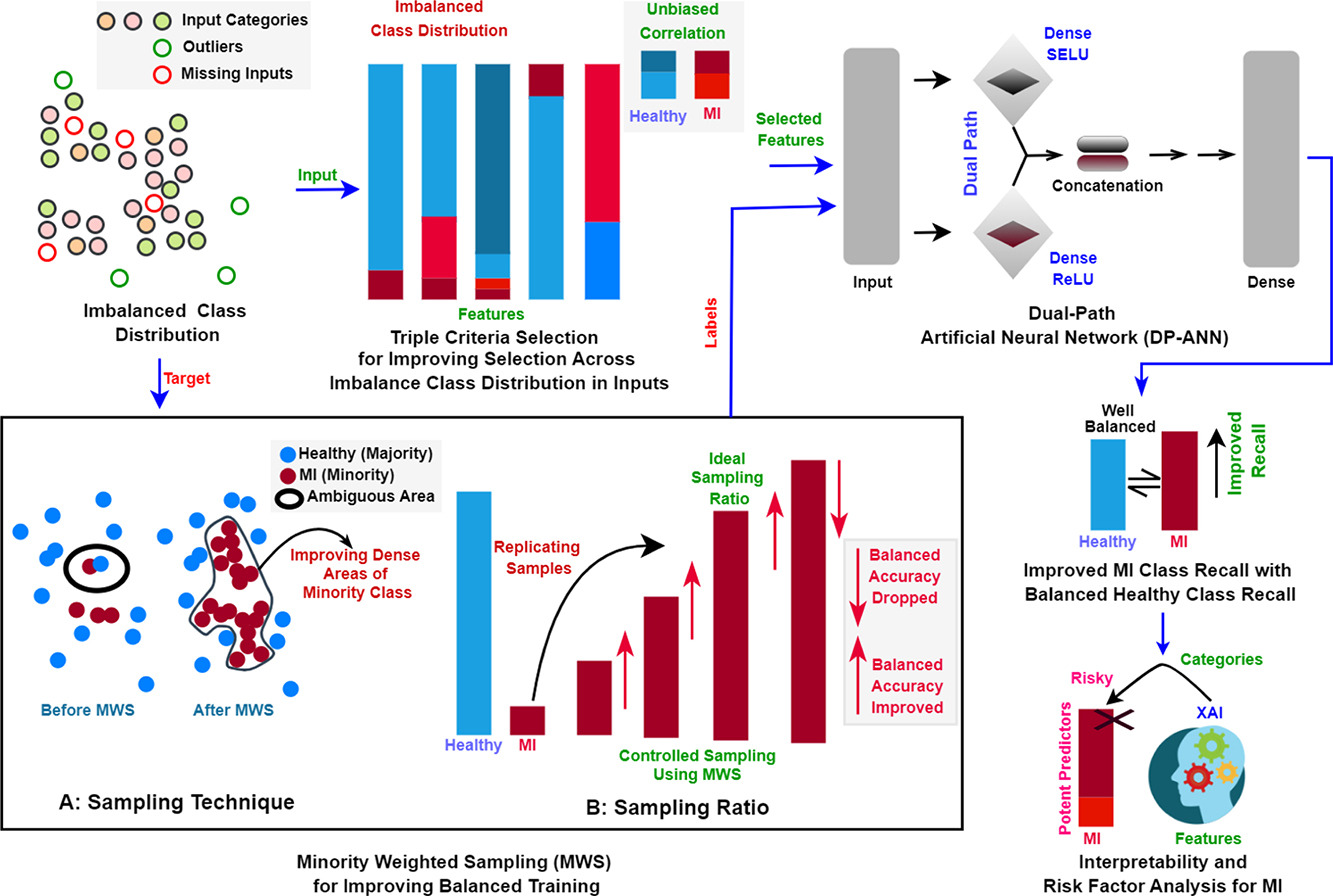
Fair and Explainable Myocardial Infarction (MI) Prediction: Novel Strategies for Feature Selection and Class Imbalance Correction.
Authors:Simon Bin Akter, Sumya Akter, Moon Das Tuli, David Eisenberg, Aaron Lotvola, Humayera Islam, Jorge Fresneda Fernandez, Maik Hüttemann, and Tanmoy Sarkar Pias.
The rising incidences of myocardial infarction (MI), often affecting individuals without traditional risk factors, highlight the urgent need for improved early detection using personal health data. However, health surveys and electronic health records (EHRs) frequently suffer from class imbalances, leading to prediction biases and differences between specificity and sensitivity, which hinder reliable model development despite the valuable insights contained in these datasets. To address this, we have introduced a novel approach to enhance MI risk prediction using self-reported attributes from the Behavioral Risk Factor Surveillance System (BRFSS) and the National Health Interview Survey (NHIS) dataset. Our approach incorporates three innovative techniques: the Dual-Path Artificial Neural Network (DP-ANN) to mitigate biased decision making across imbalanced datasets, the Triple Criteria Selection (TCS) for unbiased feature selection, and Minority Weighted Sampling (MWS) to tackle challenges of uncontrolled minority class sampling. These methods collectively enhance MI prediction and feature relevance. The DP-ANN model has achieved balanced performance, with an average specificity of 80%, sensitivity of 82%, and AUC–ROC of 89.5%, improving imbalance variance by approximately 14.96% compared to prior studies. By outperforming other models across four heavily imbalanced datasets, our approach demonstrates robustness and generalizability. Additionally, SHapley Additive exPlanations (SHAP) analysis has revealed key predictors and risk factors for MI, such as coronary heart disease and bronchitis in females, and stroke among individuals aged 35–54. In conclusion, our study provides a robust model for healthcare professionals to assess MI risk through targeted factors, promoting early detection and potentially improving patient outcomes.
Highlights
Dual-path ANN improves myocardial infarction prediction across imbalanced datasets.
Triple Criteria Selection ensures unbiased, relevant MI feature selection on imbalanced data.
Minority Weighted Sampling improves the handling of imbalances in MI prediction.
SHAP analysis identifies key MI predictors and risk factors, enabling informed decisions.
Graphical Abstract
Journal2024
Ensemble Learning Based Transmission Line Fault Classification using Phasor Measurement Unit (PMU) Data with Explainable AI (XAI).
Authors:Simon Bin Akter, Tanmoy Sarkar Pias, Shohana Rahman Deeba, Jahangir Hossain, and Hafiz Abdur Rahman.
A large volume of data is being captured through the Phasor Measurement Unit (PMU), which opens new opportunities and challenges to the study of transmission line faults. To be specific, the Phasor Measurement Unit (PMU) data represents many different states of the power networks. The states of the PMU device help to identify different types of transmission line faults. For a precise understanding of transmission line faults, only the parameters that contain voltage and current magnitude estimations are not sufficient. This requirement has been addressed by generating data with more parameters such as frequencies and phase angles utilizing the Phasor Measurement Unit (PMU) for data acquisition. The data has been generated through the simulation of a transmission line model on ePMU DSA tools and Matlab Simulink. Different machine learning models have been trained with the generated synthetic data to classify transmission line fault cases. The individual models including Decision Tree (DT), Random Forest (RF), and K-Nearest Neighbor (K-NN) have outperformed other models in fault classification which have acquired a cross-validation accuracy of 99.84%, 99.83%, and 99.76% respectively across 10 folds. Soft voting has been used to combine the performance of these best-performing models. Accordingly, the constructed ensemble model has acquired a cross-validation accuracy of 99.88% across 10 folds. The performance of the combined models in the ensemble learning process has been analyzed through explainable AI (XAI) which increases the interpretability of the input parameters in terms of making predictions. Consequently, the developed model has been evaluated with several performance matrices, such as precision, recall, and f1 score, and also tested on the IEEE 14 bus system. To sum up, this article has demonstrated the classification of six scenarios including no fault and fault cases from transmission lines with a significant number of training parameters and also interpreted the effect of each parameter to make predictions of different fault cases with great success.
Conference2023
Stroke Probability Prediction from Medical Survey Data: AI-Driven Analysis with Insightful Feature Importance using Explainable AI (XAI).
Authors:Simon Bin Akter, Sumya Akter, and Tanmoy Sarkar Pias.
Venue: 26th International Conference on Computer and Information Technology (ICCIT), IEEE
Prioritizing dataset dependability, model performance, and interoperability is a compelling demand for improving stroke probability prediction from medical surveys using AI in healthcare. These collective efforts are required to enhance the field of stroke probability assessment and demonstrate the transformational potential of AI in healthcare. This effective study leverages the CDC’s published 2021 BRFSS dataset to explore AI-based stroke probability prediction. Numerous substantial and notable contributions have been established from this study. To start with, the dataset’s dependability is improved through preprocessing and oversampling techniques that overcome the challenges of missing data and class imbalance. In order to identify the most promising models, eight different AI models are meticulously evaluated including DT, RF, GNB, RusBoost, AdaBoost, CNN, ANN, and MLP. The study combines top-performing models using fusion approaches such as soft voting, hard voting, and stacking to demonstrate the combined prediction performance. The stacking-based model combined with GNB, RF, and AdaBoost demonstrated superior performance, achieving a specificity of 74.06% and a sensitivity of 74.20%. The work also employs explainable AI (XAI) approaches to highlight the subtle contributions of important features across both healthy and stroke cases, improving model interpretability. The comprehensive approach to stroke probability prediction employed in this study enhanced dataset reliability, model performance, and interpretability, demonstrating AI’s fundamental impact in healthcare.
Preprint / ongoing
An Interpretable Cost-Aware Framework for Mitigating Bias in Skin Lesion Classification Across Diverse Skin Tones.
Authors: Md Mohit Hasan, Mahbuba Tasnime Suchi, Md Hasibul Habib, Sumya Akter, David Eisenberg, Fahmida Zaman Achol, A.M. Tayeful Islam, Aaron Lotvola, Humayera Islam, Chelsey Hill, Jorge Fresneda Fernandez, Md Golam Rabiul Alam, Tanmoy Sarkar Pias, and Simon Bin Akter.
Supervised by: Simon Bin Akter
Submission: Under review at Journal of Imaging Informatics in Medicine, Springer Nature
Can GPT Think Like Traditional Machine Learning and Neural Networks on Low-Volume Clinical Data?
Authors:Simon Bin Akter, Sumya Akter, David Eisenberg, Chelsey Hill, Aaron Lotvola, Jorge Fresneda Fernandez, Tanmoy Sarkar Pias, Muhammad Rafiqul Islam, Humayera Islam.
Supervisor:Dr. Yanshan Wang, Associate Professor, Department of Biomedical Informatics, University of Pittsburgh.
Faculty [Lecturer]
Northern University Bangladesh
Sep 2022 — Jul 2026 · [Study Leave]
Courses taught: Discrete Mathematics; Object-Oriented Programming (C++/Java) and laboratories; Computer Architecture; Web Technology and Database Capstones; Integral and Differential Calculus.
Research mentorship: Supervising undergraduate theses and mentoring journal clubs in health, agriculture, and other domains, with a focus on trustworthy AI and medical data security.
Volunteer Research Assistant · Remote
NJIT Neuro-Analytics Lab · Martin Tuchman School of Management, New Jersey Institute of Technology
Nov 2023 — Jun 2026
Research: Explainable machine learning for coronary and subjective cognitive disease prediction and risk-factor analysis; LLM-based reasoning; EEG-driven emotion recognition and consumer preference modeling; online review helpfulness.
Affiliated lab: Ethical Emerging Technologies (EET), Department of Information Management and Business Analytics, Feliciano School of Business, Montclair State University. Lab page ↗
Principal investigator:Dr. David Eisenberg, Assistant Professor, Montclair State University, Feliciano School of Business.
Collaborated institutions
Department of Urology, Stanford University, School of Medicine
Institute for Population and Precision Health, University of Chicago, Department of Family Medicine
Martin Tuchman School of Management, New Jersey Institute of Technology
Department of Computer Science, Virginia Tech
Department of Oncology, Wayne State University, School of Medicine
Department of Biochemistry, Microbiology and Immunology, Wayne State University, School of Medicine
Center for Molecular Medicine and Genetics, Wayne State University, School of Medicine
Institute for Data Science and Informatics, University of Missouri
Department of Information Management and Business Analytics, Montclair State University
Department of Computer Science and Engineering, BRAC University
Department of Computer Science and Engineering, United International University
Research Assistant · Undergraduate
Cyber-Physical Systems Research Lab · Department of Electrical and Computer Engineering, North South University
Jun 2021 — Dec 2022
Project: Enhancing the stability and cybersecurity of Bangladesh’s power grid in a government-funded project supported by the Bangladesh Energy & Power Research Council (B-EPRC).
Supervisor:Dr. Hafiz Abdur Rahman, Professor, Department of Electrical and Computer Engineering, North South University.
Collaborated institutions
Department of Electrical and Computer Engineering, North South University
School of Engineering, University of British Columbia Okanagan
Department of Computer Science, Queen’s University Belfast
Department of Computer Engineering, Purdue University
Power Grid Company of Bangladesh — PGCB PLC (industry collaboration)
Teaching Assistant · Undergraduate
Department of Mathematics and Physics · North South University
Jun 2021 — May 2022
Courses: Intermediate Mathematics, Pre-Calculus, and Calculus & Analytical Geometry III.
Responsibilities: Individual student support during dedicated office hours; grading assignments and quizzes.
05 / EDUCATION
Education
Doctor of Philosophy in Intelligent Systems
Intelligent Systems Program · University of Pittsburgh · Pittsburgh, USA
LaTeX, PyCharm, MATLAB, Jupyter Notebook, Google Colab, draw.io, VS Code, Code::Blocks, Logisim, NetBeans, Qt, and Microsoft Office
Expertise
Data Structures, Algorithms & OOP, Data Analysis & Preprocessing, Machine Learning & Neural Networks, Clinical Natural Language Processing (Clinical NLP), Large Language Models (LLMs), Vision-Language Models (VLMs), Agentic AI & Agentic Modeling, Generative Models & Generative Adversarial Networks (GANs), Explainable AI (XAI), Fairness & Bias Mitigation, Signal Processing, Image Processing & Computer Vision, Medical Imaging, and Clinical & Health Data
Languages
Bengali (Fluent) and English (Fluent)
Databases
SQL and NoSQL
Frameworks
Django, Node.js, Bootstrap, React, and TypeScript
08 / REFERENCES
Academic references
Yanshan Wang, PhD
Associate Professor, Department of Health Information Management, University of Pittsburgh, Pittsburgh, USA